The Australian
From the time that Keith Hayes’s seven grandchildren and four great-grandchildren have been able to speak, they have asked him about the large photo of a Timorese woman on solemn display in his living room. The littlest ones call her “the lady with the long face”.
The woman, Berta Martins, risked her life to save the life of Mr Hayes in World War II and contributed to what must be one of the greatest survival stories of that war.
Mr Hayes was lined up for execution by the Japanese on the morning after they invaded Dili, East Timor, in February 1942. Incredibly, Mr Hayes survived being shot and then bayoneted through the neck in the roadside line-up. Fifteen Australian commandos, all unarmed when captured, were executed that day.
But just as incredible is that Mr Hayes has outlived all but one member of his unit, the 2nd Independent Company, which went on to wage an effective guerilla war against the Japanese on Timor with the help of the Timorese throughout 1942.
Mr Hayes fell face down in the dirt after being shot, but after the Japanese had left he began to stir. The bullet had passed through the back of his neck and the bayonet blade hadn’t penetrated deep enough to kill him.
He was shot not far from the present location of the Australian embassy in an area near the Dili mosque which was known to the commandos as “the Arab village”.
Mr Hayes looked up and saw two young boys from the village. “I managed to get up and they came down and they took me to dear old Berta and from then on she was in charge,” Mr Hayes says.
Martins was a middle-aged woman who lived alone after being deserted by her husband. Suddenly, she had the responsibility of caring for this seriously wounded soldier thrust upon her, as well as hiding him from the Japanese.
Her willingness to help may have reflected the good relations developed by the commandos with the Timorese during the two months they had been based in the territory.
Martins made a paste out of crushed herbs to the stem the bleeding. During the day, she hid Mr Hayes in a nearby tunnel and took him back to her shack at night so that she could feed him and treat his wounds. She was terrified of being caught.
“At night-time, if there was any noise she’d wrap me up in a cane mat. People in the village must have known, but not a word was said about it. Anyone wanting a spare bob could have put me in,” Mr Hayes says.
He thinks he stayed with Martins for more than a week, and then one night she arranged for him to be taken through enemy lines back to his unit in the mountains. Martins gave Mr Hayes a pink handkerchief as a memento, and a big hug. Mr Hayes has kept the handkerchief to this day.
Fred Otway, 95, the other surviving members of the company, says the unit’s guerilla tactics were aided by the support it received from the locals. Nearly every soldier in the unit had his own offsider, known as a criado.
Mr Otway believes his company killed as many as 1700 Japanese throughout 1942 and helped to divert enemy troops away from the main contest in New Guinea.
After the war, Mr Hayes contacted Martins. They exchanged letters and he often sent money, though he says she wanted nothing for having saved his life.
His daughter Leonie Robson says that his grandchildren all know the story of Martins. “Now, it’s the great-grandchildren’s turn to learn the story,” she says.
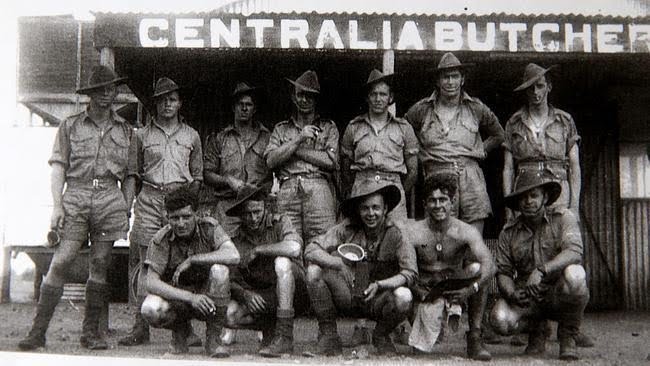
The featured image shows Keith Hayes, shirtless, with his company en route to East Timor in 1941.
Leave a Reply