The Australian
During this centenary of Anzac, Australians are being inundated with popular books on World War I and every other conflict in which our Diggers fought. In this environment, academic historian Jeffrey Grey certainly swam against the tide of populism and achieved a towering reputation.
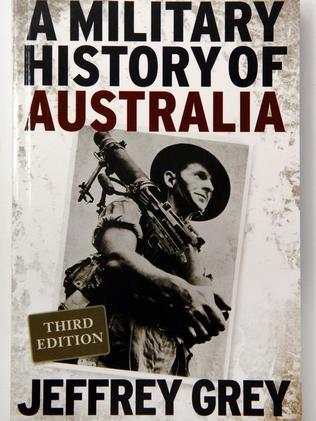
Grey, who died in late July, aged 57, taught history at the Australian Defence Force Academy for 30 years and was the author of many great works spanning the nation’s two centuries of armed conflict. His seminal work, A Military History of Australia, now published by Cambridge University Press in its third edition, examines all of Australia’s conflicts, beginning with the wars waged against the indigenous resistance by penal garrisons. This book demonstrates in a nuanced way how the military shaped Australian society, perhaps more than any other institution.
Other outstanding works include Grey’s two-volume contribution to the official history of Australia’s post-1945 conflicts in Southeast Asia, a biography of Thomas Daly, chief of general staff during the Vietnam war, and his most recent book on the Ottoman Empire in World War I.
Grey attained true international standing. At the time of his death he had become the first non-American president of the Society of Military Historians. At 40, he was appointed to a prestigious chair at the Marine Corps University in the US.
Grey’s work was set apart not only by his rigorous research and sharp thinking. His ability to write in a clear and engaging manner made his books all the more compelling. The Australian’s foreign editor Greg Sheridan put it well when he described Grey’s writing style as “educated Australian, user-friendly but intelligent”.
Retired major-general Mike O’Brien, who is also a military history expert, rates Grey as “Australia’s most internationally-recognised military historian”. O’Brien knew Grey when he was a teenager, given that O’Brien served with his father, General Ron Grey, in Vietnam.
“Jeff thoroughly researched everything he did and it was authentic and reliable. The greatest testament to his capability was becoming president of the international Society of Military Historians. That is an accolade that sets him apart from the common herd.”
O’Brien says Grey was in a vexed position because he could have secured overseas appointments, but he wanted to remain in Australia for family reasons.
In 2000, he was appointed the Major General Matthew Horner chair of military theory at Marine Corps University in the US, a position he held for two years.
Grey’s legacy can be seen not only in his published work but also in the many young historians he nurtured in his role at ADFA.
Sydney author Mark Dapin, who recently completed a doctoral thesis under Grey’s supervision, says reading Grey’s work on Vietnam, including his volumes in the official history, sparked his interest in the topic. “Reading his work about Vietnam got me interested. His perspectives were so intellectually formidable, so dismissive of received wisdom, and his clarity of expression was extraordinary.”
While Dapin says Grey was “a very clear, rational, untainted thinker”, his written expression made his work accessible to general readers. “Writing, to him, was important. Without any of the techniques of a novelist, you could read his books as easily as you could read a novel.” Grey’s singular ability cut through some of the myths generated by popular works.
As Sheridan put it in a review of A Military History of Australia, the popular books “tend to present Australian soldiers as victims … and they are weak on the policy and strategic element of our military history”. Importantly, Grey only deals with personalities where these affect “high policy”.
One of the big issues Grey took on was the received wisdom that Robert Menzies was a weak prime minister in the first two years of World War II, and that John Curtin proved strong by standing up to the British. Curtin, who became PM in October 1941, is credited with having brought back Australian troops from the Middle East against the wishes of Winston Churchill so that they could be thrown into the Kokoda campaign in late 1942.
At the time, the fight was being waged by poorly trained and equipped militias.
Grey pointed out that Curtin brought back our troops after he was urged to do so by the defence chief of staff, Vernon Sturdee, with the full support of the British officers who were heading the Australian navy and air force.
While Menzies had sent Australian troops to the Middle East in 1940, Grey wrote that it was “hard to believe Menzies would not have brought the bulk of Australian troops back to the Pacific as Curtin did”. The result was Australia was able to put thousands of experienced troops into the Kokoda campaign who would not have been battle-hardened if not for Menzies’ decision to deploy them. Grey was also critical of Curtin’s failure to stand up to US General Douglas MacArthur when he instigated the removal of a senior officer for the tactics he had used against the Japanese in New Guinea. MacArthur ordered General Thomas Blamey to go to New Guinea and sack the commander, Sydney Powell. Curtin acquiesced on this and other issues that affected Australian interests.
Sheridan points out Grey took a contrarian view when he judged the anti-Vietnam War moratorium movement did not end Australia’s role in the conflict. He says the main body of Australian combat troops was withdrawn in December 1971 and that by the time of Gough Whitlam’s landslide victory in December 1972 nearly all of our troops had been brought home.
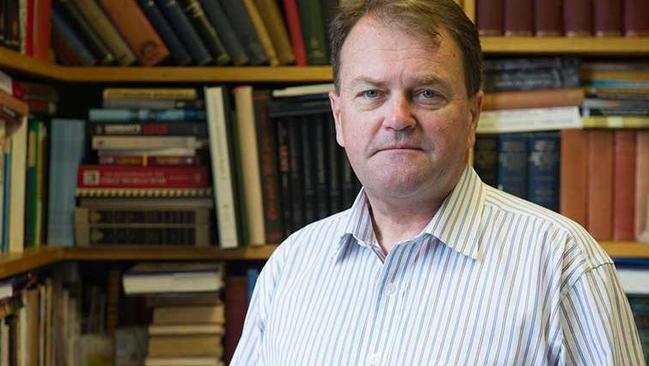
The featured image shows historian Jeffrey Grey, whose unique ability cut through some of the myths generated by other writers.
Paul Cleary is a senior writer at The Australian and the author of five books, including The Men Who Came out of the Ground.
Leave a Reply