The Australian
When the Australian Defence Force sent troops to Bougainville and East Timor 15 years ago, medical officers saw an opportunity to test new anti-malarial drugs.
Across three years, about 2500 soldiers were used in trials of drugs that were unapproved or had serious side effects on mental health. Some soldiers say they were used as guinea pigs.
Instead of prescribing the safe and tested doxycycline, medical officers prescribed 1319 troops deployed to Timor with mefloquine (branded by Roche as Lariam) even though research published in medical journals from the late 1980s on have linked it to dangerous side effects, including depression and psychotic behaviour. The consent forms said side effects mainly had been found in children weighing less than 45kg and the drug was safer than doxycycline.
Up to 578 more troops who were intolerant to doxycycline may have taken mefloquine during the past 15 years, although Defence says this estimate may involve some double-counting. Despite the known dangers, including a finding in 2006 that mefloquine can cause brain damage, Defence continues to prescribe it to a small number of troops who cannot tolerate other drugs.
In Bougainville and Timor, army medical officers also prescribed a drug known as tafenoquine to 1512 troops, even though it had not — and still has not — been approved for use by Australian authorities.
A series of allegations have now been made about the ethics of these trials and the impact they may have had on the mental health of the participants.
One serving army officer who took mefloquine, Major Stuart McCarthy, alleges the trials were “manifestly unethical” because officers compelled soldiers to take the drug without properly warning of the risks.
He’s supported by a US expert who believes the ADF trials were “deeply unethical”.
McCarthy alleges one commanding officer of troops headed for Timor told his men they would not be deployed unless they took part in the trial, which McCarthy says amounts to compulsion.
“In effect they were ordered to take a drug that exposed them to permanent neurotoxic brain injury,” McCarthy wrote in a submission to a Senate inquiry.
An email exchange obtained by The Australian reveals claims that the commander, who is now a very senior officer, told his men that refusal to take part in the trial “means you will not deploy”. The officer strongly denies ever having issued such an order, although he chose to respond via a Defence spokesperson, who says he briefed his men “that the trial was entirely voluntary, that he supported the trial and that he was going to participate in the trial”.
In evidence to a Senate committee last week, McCarthy named the ADF’s director of military medicine, Colonel Leonard Brennan, as having “direct responsibility” for the chronic illness and death of Australian and allied troops. Brennan is mentioned in academic journals as having been part of the “study team” that tested tafenoquine and he has co-authored articles about the testing of both drugs on soldiers.
Defence says: “There is no evidence that mefloquine has ever resulted in the death or widespread chronic illness in ADF members. Defence strongly refutes any claims of unethical behaviour or scientific fraud by Dr Brennan or any other investigator involved in the Army Malaria Institute clinical trials in 2000-2001.”
McCarthy goes further and claims the ADF “cooked the books” with the trial results to falsely portray mefloquine as a safe drug. While issues with trial results have been raised in research papers, there have been no specific allegations about the Australian trials. Defence says: “There has never been any dispute of the published findings or suggestion of scientific fraud.”
It also has emerged that another medical officer involved in the tafenoquine trials submitted the results as part of a PhD thesis, and was then awarded a dean’s award for excellence after being “commended by independent examiners for substantial contribution to their field of research”.
Asked how the ADF could justify prescribing the unapproved tafenoquine to soldiers, a spokesperson says: “Malaria is a disease of great military significance and endemic in much of Australia’s area of military operations. The region has large areas of drug-resistant malaria and it is in the interest of the individual ADF member and the ADF more generally to have access to effective antimalarial medication. It was the issue of drug resistance and the need to explore alternative treatments that lay behind the tafenoquine trial.”
The ADF’s blunt refusal to acknowledge any wrongdoing, and its refusal to contact the trial participants for mental health assessment as McCarthy has urged, appears to be designed to protect the reputation of senior officers, according to Defence sources.
McCarthy’s well-researched submission and evidence suggest this is not the work of a disgruntled maverick. McCarthy has served in the army for 26 years and has been deployed overseas six times, including to Iraq in 2006 and Afghanistan in 2011-12 and 2013.
McCarthy is supported by Jane Quinn, the widow of a British soldier who took his own life after taking mefloquine. Her husband, Cameron Quinn, became depressed and started having nightmares after taking the drug, in 2001, says Quinn. He used to call these nightmares his “Lariam dreams”. Cameron Quinn was serving in the British army at the time he took the drug. He took his own life in 2006.
Jane Quinn, who now lives in Australia, says the Australian military, along with its counterparts in Britain, are “stonewalling” when it comes to acknowledging the dangers of the drug. She has called for an immediate review of all troops who have been given mefloquine.
“Despite an increasing body of medical evidence, very few cases of mefloquine toxicity have formally been acknowledged in any military organisation. I know of only one acknowledged case in the British army, despite many thousands reporting significant side effects anecdotally,” she says.
“The Australian military appears to be significantly more progressive than the UK forces in terms of mental health awareness, but they are both stonewalling the problem when it comes to the treatment of personnel affected by mefloquine. Hopefully a Senate inquiry will change that.”
US expert Remington Nevin says the ADF misinformed participants about the serious risks associated with mefloquine. Nevin, a former US Army medical officer who now lectures in the mental health department at Johns Hopkins University, also has linked the drug to a spate of murder suicides perpetrated by US veterans.
Viewing the consent forms for the trials obtained by The Australian, Nevin says: “These confirm the trials were conducted in a deeply unethical manner, in that the consent forms denied the participants access both to critical safety information contained in the then approved Australian mefloquine product insert, and to best available information on the then known risks of the drug.”
The information warns people to stop taking Lariam and to see a doctor immediately if they experience depression, restlessness, confusion, feeling anxious or nervous.
“This critical safety information was not included in the consent form,” Nevin says.
“In place of this critical safety guidance, under “risks/discomfort”, the consent form instead includes erroneous information on the incidence of these and various other psychiatric symptoms.”
Defence contends that the main study, involving 1157 troops, was conducted as an “open label” trial, which means they were given access to the product warning. Another study, with 162 ADF members taking mefloquine, was conducted as a “double-blind” study, which required the participants to remain uninformed.
Nevin says that explanation is inadequate. He says the requirement to discontinue the drug should have been considered critical enough to have been included in the consent form.
He says the product insert from 1998, which he believes is the one that was current at the time of the study, “clearly does include an instruction to stop the medication at the onset of certain symptoms”. Regarding the double-blind trial, he says there was “no evidence in the documents I have reviewed that participants were properly counselled”.
The units involved in the Timor trials were 1 RAR, 2 RAR and 4 RAR. The ADF’s conduct in this trial led 240 participants to take part in a class action against the ADF and the drug’s manufacturer, Roche. But legal redress became unviable in 2004 when the Howard government amended the veterans entitlements law so that any compensation gained would be deducted from overall benefits. This change led to those 240 personnel dropping their class action.
On the broader issue, Nevin says soldiers should not be used in drug trials. He notes that prisoners also have been used to trial anti-malarial drugs and that the ADF personnel had been treated the same way.
“They are seen as no different to prisoners,” says Nevin. “It does not seem in the ADF trials that standard ethical practices were adhered to. The ethically questionable use of mefloquine in place of the preferred, safer drug doxycycline is very concerning.”
McCarthy says the trials and subsequent use of mefloquine has created a culture of “denial, deceit and impunity that extends to the most senior officers in the ADF”. Defence’s response to questions about this issue seems to underscore this point. When The Australian first asked how many personnel had been prescribed with mefloquine, the department said it had records going back to 2010. Defence admitted to these earlier trials only when The Australian pointed out they had been reported in academic journals.
When this newspaper reported McCarthy’s submission last month, the vice-chief of the ADF, Vice-Admiral Ray Griggs, issued a statement that said the article reported “unsubstantiated claims and makes a number of allegations” about the trials. He claimed the article contained errors of fact, but without saying what they were. A defence spokesperson also declined to elaborate.
Griggs said the trials were conducted under “the full scrutiny of the Australian Defence Human Research Ethics Committee”, but the department so far has refused The Australian’s request to release the minutes of relevant committee meetings. It has declared the minutes are “privileged”.
Warnings about the damage done by mefloquine are now overwhelming. The US Department of Veterans Affairs declared in 2004 that mefloquine could result in “severe and persistent” adverse effects, even after people had stopped taking the drug. In 2013, the US Food and Drug Administration issued a “black box” warning, its most serious warning, and declared the drug can result in permanent brain damage. “Neurologic side effects can occur at any time during drug use, and can last for months to years after the drug is stopped or can be permanent,” the FDA said. In the same year, US Special Forces banned the drug.
Even so, it is still available elsewhere in the US military, and in the Australian and British military. Travellers in Australia can obtain the drug and the Therapeutic Goods Administration does not warn of permanent damage. Nor does it issue a prominent warning as does the FDA.
The real issue now is what should be done to address the impact on trial participants. McCarthy appears to be one of many individuals whose life has been harmed by the drug. Both the Defence Department and the Assistant Minister for Defence, Stuart Robert, have dismissed McCarthy’s call for the department to contact all participants and assess their mental health. They say this would cause “unnecessary distress” to those individuals.
McCarthy says the conduct of the ADF, Roche and the TGA in relation to mefloquine should be investigated by a judicial review.
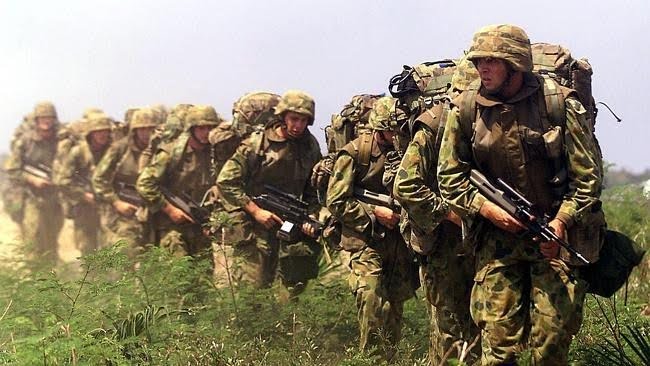
The featured image was taken on 20 September, 1999, and shows armed troops in “Operation Stabilize”
Leave a Reply