The Australian
Whitehaven Coal’s Werris Creek colliery in northern NSW is a modest mine by any measure.
At 2.5 million tonnes of coal output a year, this is one mine that was meant to underscore claims that mining could coexist with intensive agriculture.
But jump on to any satellite website and you’ll get some idea of the issue that has the locals up in arms.
About 3km south of the mine is the Quipolly Creek, which farmers say was until recently a “spring-fed oasis” that had always supplied water, even in the most severe droughts.
On either side of the mine, the creek is clearly defined by lush green vegetation along its banks, but the vegetation fades along a 5km stretch immediately south of the mine, making the creek barely visible.
Anthony McCulloch, whose farm includes this dry patch, says the water levels in his bores have dropped by 6m in the past eight years, even though he uses bore water only for his livestock. Notwithstanding the drought, he says the mine is draining the aquifer.
“From the bottom of our creek to the bottom of the pit is a drop of more than 100m. Water doesn’t run uphill,” McCulloch tells The Australian.
He says locals who have lived in the area for more than 70 years say the creek is “the driest it has ever looked”.
Another farmer, who asked not to be named, says: “Quipolly Creek is now a sick stream compared to the vibrant stream that it was.”
Agriculture Minister Barnaby Joyce, who is also the local federal MP, has been raising farmer concerns about the mine’s impact on the water resources of the immediate region.
Joyce says Werris Creek was meant to be the perfect place for a mine because there was apparently no connection between the site and the Quipolly aquifers, but he says this has been proved wrong.
He notes that while farmers’ bores have run dry, the mine has so much water that it is spraying it up into the air. Whitehaven, however, says it has been drawing less than half its 211-megalitre allowance each year and it blames the difficulties faced by farmers on the drought.
Last week, Whitehaven hosted a meeting in Werris Creek attended by about 50 farmers who vented their frustration over the loss of water and the impact this has had on their land value. Whitehaven had experts on hand to respond to these concerns.
For the farmers in the surrounding region, including the highly productive Liverpool Plains just 20km to the northwest, the experience of Werris Creek is ominous because they have a much bigger mine heading their way.
The mine proposed by China’s giant Shenhua Energy plans to extract 10 million tonnes of coal a year amid rich black soil plains and abundant aquifers, before leaving behind a massive hole in the ground.
The similarities between Werris Creek and the proposed Shenhua mine are striking, and this makes the potential impact of the latter all the more concerning. Quipolly Creek is in fact a tributary of the Mooki River, which runs near the proposed mine site.
Shenhua’s own modelling says that it will draw 35.7ML of groundwater each year, on average, which it describes as a “negligible quantity”, as it is about 25 per cent of the average pumping rate of a single licensed agricultural bore in the area.
Its modelling shows 35 nearby bores are predicted to be affected by the mine, although only four will suffer falls of 1m or more.
But the federal government’s Independent Expert Scientific Committee says potential impacts on groundwater-dependent ecosystems associated with the Mooki River “have not been well characterised” in Shenhua’s environmental impact statement.
“There is no consideration of the potential ecological impact of groundwater drawdown on the instream community in the Mooki River. The combined impacts of loss of streamflow as well as changes to water quality, particularly salt loads during ‘first flush’ events on Native Dog Gully and the Mooki River, should be further considered,” the IESC says in its report on the project.
The IESC calls on the proponents to carry out more detailed modelling. The IESC also is concerned about the project’s plan to leave behind a final void, rather than fully rehabilitate the site.
Shenhua plans to backfill the eastern and southern pits but will leave a western pit covering an area of 100ha down to a depth of 60m. The IESC says “both the final void and seepage from backfilled pits present potentially significant long-term environmental hazards, which have not been adequately addressed by the proponent”.
In response to these concerns, Environment Minister Greg Hunt has said the mine must submit plans for water management, water impact verification and rehabilitation before it can start. He has pledged to send these back to the IESC for further review.
“If they are not satisfied I won’t even approve that,” Hunt told radio host Alan Jones.
Should Hunt approve the mine, says sixth-generation farmer Tim Duddy, who heads the Caroona Coal Action Group, then the group will mount a legal challenge aimed at the legal basis of Shenhua’s development application.
Duddy tells The Australian CCAG has engaged a “top-tier” law firm to challenge any Shenhua approval and a nearby exploration licence held by BHP Billiton. CCAG is looking to take action in a federal jurisdiction aimed at examining “whether the entire development application is valid”.
In the past CCAG has been funded by the Australian Farmers Fighting Fund. The criteria for financial support are cases that aim to establish legal precedents that will be helpful to other farmers. Any legal challenge also may count on the support of some of the wealthiest and most productive farmers found anywhere in Australia.
The Liverpool Plains, as well as being a stunningly beautiful place, produces an abundance of grain not just once but twice a year. Figures released by the Department of Agriculture show the Liverpool Plains’ productivity is indeed impressive.
Its wheat output per hectare is 66 per cent higher than the national average, and the region outperforms on a whole range of crops. For sorghum the yields are 89 per cent higher; field beans are 74 per cent higher and canola yields are 54 per cent higher.
Duddy states emphatically that the Liverpool Plains has the best land found anywhere in the country, and is indeed comparable with the world’s best farming regions. Exposing this region to a coalmine is too great a risk, he says. Even though the federal environment minister has the right to shut down the mine, he says any such decision would be made too late.
“It’s the best land in the state. It’s the most productive, next to none. If they contaminate the aquifer then every business in the Liverpool Plains is unviable. Hunt put in stop clauses, but the day they stop the mine, every business will already have become unviable,’ says Duddy.
As farmer Hugh Pursehouse explains, the combination of water resources and fragrant black soils makes the Liverpool Plains particularly productive, and the intensive nature of the farming makes the industry a big employer.
“There are a lot more jobs here in farming. We produce two crops a year. There are not many areas in Australia where you can get two crops a year,” Pursehouse explains after a hard day out in the field.
He believes the farmers will be able to muster significant support from around Australia to stop the mine. To this end, Pursehouse, 23, and his partner Maddy Coleman, 24, are part of a new group called Liverpool Plains Youth, which is dedicated to keeping the Liverpool Plains free of mines. The young group has been using social media to rally support.
“Civil disobedience will end up stopping it. People will not allow it to happen. The blockade will be 10 times bigger than Maules Creek. There will be a lot more people behind it. It will be the biggest blockade since Franklin,” says Pursehouse.
Coleman, originally from Sydney, has taken to farming with gusto and says the concerns of ordinary Australians about the quality of their food will take this fight to a new level.
“We have got Australia behind us,” she says.
Sarah Sulman, 24, says the prospect of a coalmine in this area has brought the community together like never before. Sulman was reared in nearby Tamworth and moved to the Liverpool Plains to help her grandparents with their farm.
“We all share the same passion for this land,” says Sulman.
Small business owners in Gunnedah, the biggest town in the region, are reluctant to speak publicly about the mine because it has divided the community so deeply.
Council members who come from business backgrounds see the benefit of the mine, and it’s these members who recently went on a trip to China to examine a sister-city relationship. They are looking at the Linhe district because it is also home to a Shenhua mine.
“We have to sit on the fence so much that we get splinters up our backside,” says a local estate agent.
The owner of a substantial retail business who spoke against the mine asked not to be quoted, fearing a backlash from the pro-mine faction.
On one level, there is some truth in the claims that the Liverpool Plains may encourage a very broad coalition of support. But likening this looming battle to the Franklin River campaign misses the point. The blockade to stop damming the Franklin in the early 1980s was about preservation of wilderness, and its supporters were mainly green in colour.
Mainstream green groups have been largely ignoring the Liverpool Plains, even though it is home to an abundance of koalas that live on the wooded ridges above the plains.
Instead, they’ve focused on the proposed Galilee Basin coalmines in Queensland because they involve shipping coal through the Great Barrier Reef, even though the economics of those mines are dubious.
Shenhua’s mine lease has soft coking coal, which has held up in price, and it is located near existing infrastructure. Coal trains already pass through the Liverpool Plains, shipping coal from mines farther north to the Newcastle Port.
But the blue-blood farmers who can trace their ancestry back to the 1840s can marshal significant financial resources to mount a legal challenge. There’s also indigenous opposition stemming from the sacred sites found in and around the mine site, and there are the rednecks who won’t like prime Australian farm land being dug up by a Chinese company.
But the politics of this region is complex. Former Nationals leader Tim Fischer cites the March NSW election result in which anti-mine candidate Peter Draper was defeated by sitting Nationals MP Kevin Anderson.
“The people of that area had a vote on this not so long ago. It was called the Tamworth state seat. We had an independent, Draper, scream anti-mining slogans all over the polling booths and public meetings in that very area. Interesting 65 per cent of the people in that area voted for Kevin Anderson,” Fischer says.
However, Draper suffered a stroke during the campaign and the Nationals poured a huge amount of money into the seat.
As a result of Hunt’s commitment to re-examine Shenhua’s modelling, the NSW government has yet to receive a formal application for a mining licence.
When it does, the decision to issue the licence will be a mere formality, according to state government sources.
This is why the looming legal challenge will be the next flashpoint in this long-running dispute.
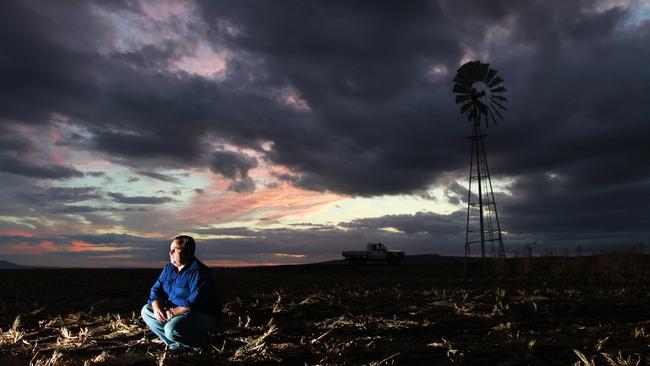
The featured image shows Farmer Tim Duddy on his property near Quirindi in northwest NSW. Tim is concerned about the underground water reserves and the flow-on impact to the wider river system from mining company Shenhua Watermark Coal who have purchased neighbouring properties in the area to begin open cut mining operations.
Leave a Reply