The Australian
He wears a pair of Clark Kent glasses, and with his tall, solid build, this senior air force officer could easily play the part of Superman. But the man charged with delivering Australia’s $17 billion defence baby, a fleet of 72 F-35A Joint Strike Fighters, doesn’t just look the part.
Air Vice-Marshal Leigh Gordon, 55, has a truly super CV that’s loaded with the right stuff. Which is just as well because his current project, no doubt the pinnacle of his career, seems to be so challenging and complex that it may require a heroic effort.
It’s rare to meet someone whose career background seems to have prepared them so perfectly for the biggest moment of their working life, but Gordon is one such man of the moment.
He heads a team of 140 people that has the job of integrating the RAAF’s F-35As into Australia’s defence network while building linkages with Australian industry to supply parts and servicing for the planes. (The F-35 comes in three variations, A, B and C, and all of Australia’s will be the A-model.)
Australia’s first two F-35s, known as AU1 and AU2, will be officially unveiled today at the Avalon Airshow in Geelong, Victoria. They are based at Luke Air Force Base in Arizona, where Australian pilots are training on them.
The RAAF has contracted to have the first squadron, Number 3 Squadron, fully operational in 2021, and all 72 aircraft in the field by 2023.
Given the controversy over long delays and cost blowouts for this fifth-generation aircraft, the question has to be this: if it had been your decision, would you have opted for the F-35?
Gordon is adamant that Australia made the right choice. He explains four key reasons why the F-35 is the best option for our defence needs for the next three to four decades.
“I would have most certainly gone with the F-35. You need to understand the concept of fifth generation. It is a concept. It’s not a textbook definition, something you can sit down and measure,” he explains.
“The thing that makes the F-35 fifth generation firstly is its stealth. It has been designed as a stealthy aircraft with low reflective surfaces, engines hidden from view, it has that stealth. The second thing, it has some fantastic sensors, quite a leading-edge radar, the DAS cameras — the distributed aperture system cameras — which give you a 360-degree view of the world out to a huge distance.
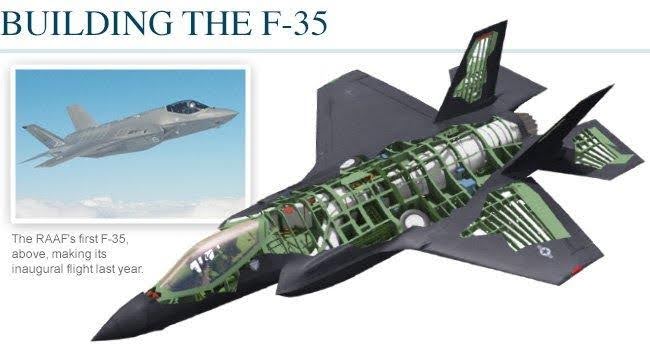
“The third thing is the way all those sensors are fused together to inform the pilot. The fourth thing is the ability to transfer data to other F-35s and indeed other aircraft. That combination of characteristics is not in any other aircraft in service. The F-35 is a multi-role plane that is more appropriate for Australia’s needs than any other.”
Intense public scrutiny has made the job of bringing the project to fruition all the more difficult. The internet is awash with stories about delays and glitches. Gordon confirms he has to remind his team to take the long view.
Perspective is something Gordon seems to have in spades. He explains how he sees his job as “in a lot of ways just helping people keep their focus on the big picture”. Staff often look to the next milestone, such as the next delivery date, but “we have got to deliver a whole-of-life capability”.
“It is not just about two aircraft in Australia by the end of 2018, it is about something a lot bigger than that. It is a 35-year view.
“We have to make sure we have a training facility. We have to have a logistics system that supports the organisation, and work with international partners to make sure the jet remains relevant across its life.”
Gordon’s perspective is helped by having worked on projects that have involved taking risks and pushing the limits of technology — and delivering big returns. The E-7A Wedgetail aircraft, which provides Australia with advanced air battlespace management capability, has many parallels with the F-35, he says.
Despite his stellar career, Gordon seems to be a grounded bloke from a country background. He spent his mid-teenage years on the edge of NSW’s western plains where he attended the local public school, Parkes High School. He gained an engineering traineeship with the council where, among other things, he checked water meters and tested the concrete on water towers in the dusty wheatbelt town of Peak Hill.
But he had wanted to join the air force from a very young age after watching countless episodes of 12 O’Clock High, a World War II drama about American bombers that flew over Europe, which was shown on ABC TV when Gordon was aged about five or six.
At age 20, that dream became a reality when he won a cadetship with the RAAF to study aeronautical engineering.
Over the past three decades Gordon could have left the RAAF for a job with an aerospace multinational, but the richness of opportunity and technical challenges have kept him in the service.
And he makes the point emphatically that he likes serving the nation, just like his three uncles who fought in New Guinea during World War II. Rex and Austin Pateman served in infantry battalions, while his namesake Leigh Pateman joined a motorised unit. Gordon’s paternal grandfather, Wallis, was an engine fitter who worked on the supply planes that supported the ground troops, while his maternal grandad, Alex Pateman, joined a volunteer home defence unit at age 60. Gordon’s wife, Adele, is also in the RAAF.
After a 100-day posting to the Middle East during the second Gulf War, Gordon has played a prominent role in commissioning new aerospace capability that propels Australia towards the objective of becoming the world’s most advanced air force by 2025. “As far as staying in the air force (is concerned), I have had some fantastic jobs in my career, working on flying units, serving on operations, running significant logistics and engineering organisations,” he says. “I have been involved in quite a few of the major acquisitions of late, the P-8 (Poseidon), the Wedgetail, even the Growler I have a chance to work with, the PC-21s. I’ve been involved in some really exciting activities.
“And the job I have got at the moment in the JSF project, if I don’t enjoy this job I have had the wrong career. It is just a fantastic opportunity to really set up something for Australia for the next 30-40 years.”
He explains that the problems that have emerged with the project are an inherent part of pushing the boundaries of technology. The F-35 is a very software-intensive project and given the “level of capability they were aspiring for, there are going to challenges”.
The latest challenge means that our aircraft may arrive with software that has less capability, known as Block 3i, rather than Block F. However, the US Marines have carried out highly effective exercises while using Block 3i.
Gordon argues that the decision to overhaul the project in 2010 — known as re-baselining — has made a massive difference to its outlook. In early 2012, the team conducted a complete overhaul of the cost, schedule and capability outcomes of the project.
This week, Gordon lined up at the Avalon Airshow alongside his US counterpart, Lieutenant General Christopher Bogdan, the program executive officer for the F-35. Together the two men sought to shoot down the misconceptions about the aircraft with a forthright account of its recent performance.
Bogdan outlined the exceptional performance of the F-35 in virtual combat engagements over the Nevada desert last year. He admitted there were ongoing risks and problems, but the aircraft had come a long way from where it was before the re-baselining.
Bogdan, who prosecuted his case with a gruff New Jersey accent, began with the bottom line: “If called upon (we’re) willing to send it into combat. Since 2013, it’s a very, very different program (and now on) a much, much better trajectory than four years ago.”
He said the results of the marines’ exercises last year were hugely significant. “The results for both of these for the F-35 was pretty impressive. It dominated those two wartime gaming exercises.”
In one exercise that involved shooting down a drone that was over the horizon, the F-35 worked with a ship that had the AEGIS system and was able to destroy the drone with an SM-6 missile.
More significant is the way the aircraft works with other planes in the same battle space. Says Bogdan: “It makes everyone in the battle space smarter, more lethal and more survivable.”
The US Air Force is now confident that the F-35 program is on track to meet its production targets after having produced 134 planes in the lot 11. This is almost double the 61 units produced in 2015, and by 2020 the plan is to reach a target of 160 units.
And while production is increasing, the price is coming down. The price for lot 10 was $US95 million and by 2019 it is projected to come down to less than $US85m. “We need it lower in 2019, less than $US85m. I think we can get there. We need to be looking at an $US80m plane by 2019. We need to be driving to a $US80m A-model. I think we can get there,” says Bogdan.
This doesn’t come without risk. Bogdan is worried that problems with the early model F-35s will be a drag on the ramp up, because these planes need servicing and parts.
He says that software is another risk, but this will be the case now and for decades to come. This is an inherent part of building an aircraft with complex sensors and communications software.
The software for Lockheed Martin’s Autonomic Logistics Information System is very, very complicated, and he says there is a lot of work to be done. “Quite frankly, it’s late,” he says.
Gordon thinks Australia has taken an astute approach to this acquisition. Back in the early 2000s, when the government became a partner, Australia gained “very good visibility of how it was progressing and this allowed us to get Australian industry involved”.
“Some of the companies, Quickstep comes to mind, were involved in doing design work in support of the program fairly early on. That has been a great advantage to us,” he says.
More than a dozen Australian companies had won contracts worth $800m by the end of 2016, with the potential for this to increase to $2bn by 2023 as production ramps up. A PwC report out today estimates the Joint Strike Fighter project will create 5000 jobs by 2023.
Levett Engineering chief executive Paul Levett, who began his working life as a fitter and turner with the Defence Department, credits a trade mission back in 2003 for the success that Australian business has had in winning F-35 work. Levett is the only Australian business making parts for the Pratt & Whitney engine; all up it’s making 10 parts — four of them with other businesses — for the F-35 that extend all the way from the nose to the tail.
BAE Systems has won the contract for maintaining the F-35 in the southern Pacific region.
Australia elected to buy the first 14 units in 2009 and did not fully commit to the balance of the program until 2014 — which is a significant date as it follows the re-baselining. Gordon says Australia took its time, went into the project with “eyes wide open, and once it was looking healthy, committed to the big buy”.
He likens the F-35 approach to the strategy used for the Wedgetail, which involved taking risks and has delivered big returns.
The big challenge now is for Gordon’s team to integrate the F-35 into our defence network and to avoid the problems that Australia has had in recent years with the Tiger attack helicopter, which has suffered from a raft of capability and systems integration problems.
“For the Australian schedule, the area we have to focus on is integrating the capability in Australia. How is it going to operate here, how will the communications systems and information systems hook up to Australian systems. Will the training and spare parts be up to scratch?”
One of the recent priorities has been building an information support centre for the F-35 and its ALIS software at Williamtown air base in NSW. This centre will be able to test new software loads as they come out from the US. This is why part of Gordon’s team is based in the US, “immersing themselves in the supply chain and the data as part of that global support system”.
Given the expertise that Gordon is developing in this role, it is a concern that someone of his calibre will face retirement in five years. He deflects the question by saying there are many people with greater skills than he has who are coming through the ranks.
“When I sit down with the squadron leaders of today, I think they’ve got far more business acumen and they’re far more technically competent than I could ever remember being.
“So we’ve really got to make sure that we create an organisation where those competent people can get on as well. We have to have a healthy degree of churn in the organisation.”
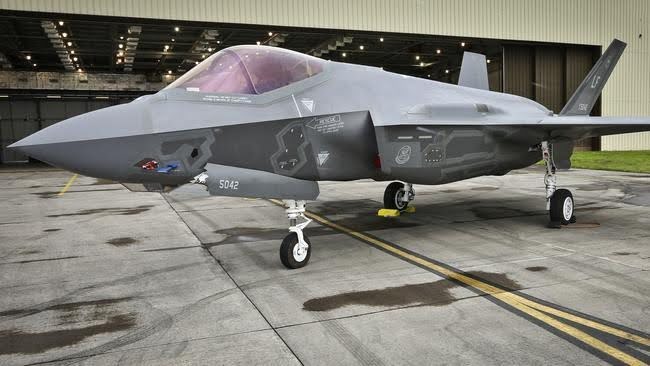
The featured image shows an F-35A Lightning II during the Royal International Air Tattoo at RAF Fairford in England.
Leave a Reply