The Australian
Garth Callender wrote reports “to save lives” during an eight-month tour in Afghanistan in 2009, his third deployment to a war zone in five years. His dispatches contained forensic analysis of the improvised explosive devices used by insurgents to kill and maim coalition troops and Afghans, which at this time were taking out vehicles and patrols on a daily basis.
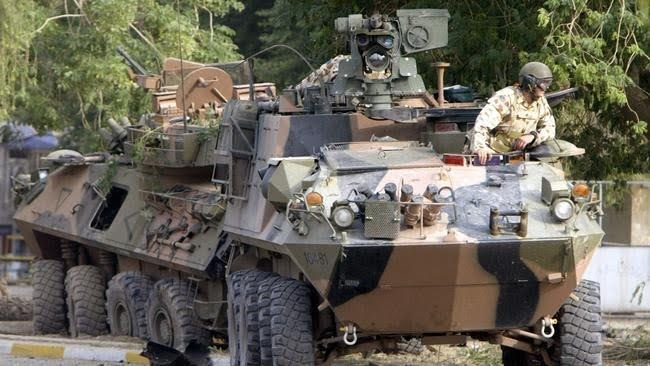
Callender had a personal connection with the task at hand. In October 2004, two months into his first deployment to Iraq, he was manning the turret of a 13-tonne armoured vehicle when it was blown up by an IED while patrolling a car-lined street in Baghdad.
The blast killed two Iraqi children and a man, and left a giant plume of dust and smoke hanging over Baghdad. Callender became the first seriously wounded Australian in this conflict.
The nature of Callender’s wounds was so serious that US surgeons who operated on him thought they may need to “reseat” his brain, yet he made a remarkable recovery. More remarkable, though, was that 16 months later he was back in Iraq as second-in-command of his former unit, which provided security for Australia’s diplomatic mission.
Drawing on his ground-level experience in Iraq and later Afghanistan, After the Blast provides a rare and valuable insight into the work of a mid-level officer in the field. Callender’s ability to write cogently and easily about these events — a skill no doubt honed by his war service — is one of the real strengths of this account of three extraordinary tours of duty.
The blast was just one of many terrifying moments Callender had to contend with. Another was the tragic death of Private Jake Kovco, who died as a result of a single gunshot wound to his head. Kovco was a member of Callender’s 111-member team.
This book reveals much about the immense toll war takes on defence personnel and on their loved ones. Callender’s then fiancee Crystal methodically smashed all of their crockery the day he told her he was going back to Iraq, but they went on to marry a few months before his departure.
His reason for wanting to return is put simply but convincingly: “I didn’t know why I was so keen to return … I did know I was the right man for the job.”
Returning to Baghdad, he found it no safer than when he was last there, even though the Australian mission had moved into the green zone. Commanding an armoured vehicle on his return, he turned into the same car-lined street where he had previously been blown up. As he approached the depression in the road left by the blast, Callender faced a harrowing moment, but one that passed.
On arriving at the base in March 2006, Callender and his senior officers realised it afforded little protection against rocket attacks, so they arranged for Iraqi contractors to reinforce it with concrete T-bars up to 3m thick. The job was finished three weeks before an attack that seriously wounded a female corporal. The concrete no doubt saved lives.
While Callender’s war service seems to make him stronger, he recounts in a measured way the toll on those who served alongside him. His commanding officer, who bore the brunt of the Kovco inquiry and intense media scrutiny, returned home to find his wife uninterested in his war service. He then discovered she has been having an affair and his marriage was over.
There’s the young soldier, Jamie, who killed an Iraqi and wounded others in a vehicle that failed to stop at a checkpoint. He was one of three Diggers who fired at the vehicle and even though they followed the rules of engagement, Jamie took the event very badly.
While Jamie was a “real character”, he was also deeply religious and he became convinced that he would one day burn in hell. Shortly after returning to Australia, Jamie was killed in a motorcycle accident.
Matt Millhouse, who was in the armoured vehicle with Callender when it was blown up, escaped physically unscathed but was diagnosed with dementia a decade later at the age of 34. He now lives in a nursing home.
After these two tours, Callender had manifestly done his bit and it was now time to focus on family. After suffering the painful loss of a stillborn baby boy at 21 weeks, Crystal gave birth to a healthy baby girl about a year later.
The family moved to Canberra where Callender talked his way into a counter-IED taskforce that was dealing with Afghanistan’s most lethal weapon. He then saw a job in Afghanistan with his name on it, and he volunteered again.
For this deployment, Callender reassured his wife that he would be safe behind a desk, but in fact he ranged far and wide across the badlands of Afghanistan to learn firsthand about the Taliban’s use of IEDs. He wore a pager that went off day and night when incidents occurred.
During this deployment he learned that Crystal was pregnant with their second child, which was due around the time of his return. She would be alone for the entire pregnancy. Given the immense strain this placed on his family, Callender became determined to make his mark.
“I had to make a difference, have a strategic impact, write reports for everyone from corporals to generals — help save lives,” he writes.
Callender’s army career ended after 17 years when he was pressured by his commanding officer to accept a fourth deployment. This time, Crystal spoke up and said it was time to leave.
At a time when the defence force is mired in controversy and the situation in the Middle East seems overwhelmingly bleak, After the Blast shows us that military service can be a true calling. It serves as a reminder that Australia’s servicemen and women do indeed save lives and help to make the world a safer place.
The featured image shows Australian forces securing Baghdad’s Karrada area in October 2004 following a blast.
Paul Cleary is a senior writer at The Australian and the author of four books, including The Men Who Came out of the Ground.
After the Blast: An Australian Officer in Iraq and Afghanistan
By Garth Callender
Black Inc, 256pp, $29.99
Leave a Reply